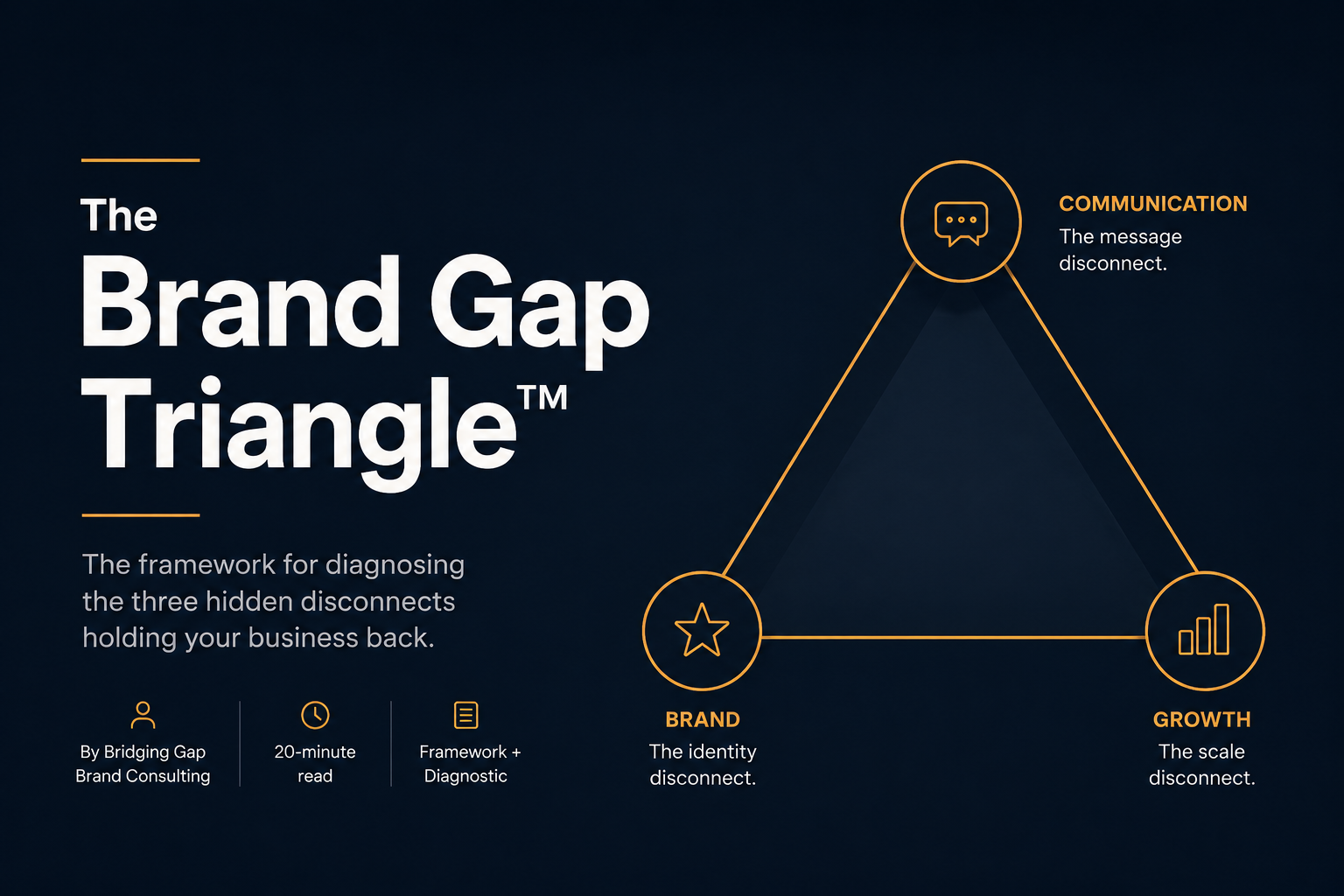
Why most businesses are broken in the same three places — and the framework I have used for twenty years to fix them. By Bridging Gap Brand Consulting || 20-minute read || Framework + Diagnostic
Introduction
The Brand Gap Triangle™ is a strategic framework designed to identify the three hidden disconnects that quietly damage business growth, brand credibility, positioning, and communication. In twenty years of brand consulting, I have never met a business that was broken in a completely original way.
The names change. The industries change. The scale changes. But the underlying problem — the reason a business’s brand is not doing what it should — almost always traces back to one of three places.
In twenty years of brand consulting, I have never met a business that was broken in a completely original way. The names change. The industries change. The scale changes. But the underlying problem — the reason a business’s brand is not doing what it should — almost always traces back to one of three places.
I call it the Brand Gap Triangle™.
It is not a theory. It is a pattern I observed over hundreds of engagements, distilled into a diagnostic framework that I now use at the beginning of every client relationship. It tells me, within the first few hours of working with a business, exactly where their brand has broken down — and what it will take to fix it.
I am sharing it here because I believe every business leader deserves to understand this. Not to do the work themselves — but to understand what they are actually looking at when their brand is not performing the way it should.
The Observation That Started Everything
Early in my career, I noticed something that nobody was talking about.
Every brand project I worked on was described as a different problem. One client needed a new logo. Another needed a website redesign. A third needed help with their marketing communications. A fourth wanted to “refresh” their brand without knowing quite what that meant.
But when I got beneath the surface of each brief, I kept finding the same thing.
The problem was never really the logo. It was never really the website. It was always one of three fundamental disconnects — a gap between what the business actually was, what it said about itself, and how it looked to the outside world. And here is what made it interesting: these three gaps almost never appeared alone. They travelled in pairs. Sometimes all three showed up together. And when they did, no amount of design work, copywriting, or campaign activity could fix the underlying problem — because the problem was structural.
A brand doesn’t fail in isolation. It fails at the junction between strategy, identity, and message. Fix one without the others and you have spent money on a symptom.
That insight became the Brand Gap Triangle™. And it has been the foundation of every engagement I have taken on since.
The Brand Gap Triangle™
The framework is built around three corners and the three gaps between them.
The Three Corners
01. Strategic Foundation
What your brand stands for — and who it stands for.
02. Visual Identity
How your brand looks, feels, and is recognised.
03. Brand Voice
What your brand says and how it says it.
Most businesses understand these three elements exist. What they do not understand is that the damage happens in the space between them — in the three gaps.
Gap A — The Strategy-Identity Gap
This is the most common gap I encounter, and the most expensive one most businesses never notice.
It happens when a business has evolved its strategy — grown, repositioned, moved upmarket, entered new sectors — but its visual identity has been left behind. The business is not what its brand looks like anymore.
The result is a credibility mismatch.
A business that has become sophisticated, premium, or enterprise-ready but still looks like the startup it used to be. A business that has built genuine competitive differentiation but presents itself in a way that is indistinguishable from its competitors.
Your brand is a promise. If your visual identity is making a different promise to the one your strategy intends — you are paying the price every single day, in ways you cannot easily measure.
Signs You Have a Strategy-Identity Gap
Your team feels embarrassed sharing branded materials with senior prospects
Enterprise or premium clients hesitate before the conversation even starts
Competitors with inferior products are winning deals on perceived credibility
Your leadership team describes the business one way and the brand looks another way entirely
You have updated your strategy or positioning in the last three years but not your visual identity
What Fixing It Looks Like
This is not a logo redesign. It is a strategic realignment — a process of understanding where the business genuinely is, where it is going, and building a visual identity that earns that position rather than undermining it.
Gap B — The Identity-Voice Gap
This gap is subtler. And in some ways, it is more damaging — because it is harder to see.
It happens when a business has invested in a strong visual identity — one that looks premium, professional, and trustworthy — but the words it uses to describe itself do not match. The language is generic. The messaging is interchangeable with any competitor. The voice has no personality.
What happens is a kind of cognitive dissonance in the mind of the buyer. The brand looks serious. But what it says does not feel serious. The design promises something the words fail to deliver. I have walked into boardrooms where the presentation deck is beautifully designed — and the words on every slide could have been written by the competition.
Nobody in the room notices. They have been looking at it for so long that they have stopped hearing it.
If you cover the logo and the message still sounds like it belongs to your competitor, you do not have a brand. You have a template with your colours on it.
Signs You Have an Identity-Voice Gap
Your website looks impressive but generates few qualified enquiries
Prospects say they “liked your materials” but ask questions that suggest they do not understand what you do
Your sales team rewrites or avoids using the official brand messaging
You can describe your business compellingly in conversation but your written materials fall flat
Every industry event you attend, your competitors sound exactly like you
What Fixing It Looks Like
Brand messaging work — not copywriting. There is a difference.
Copywriting produces words. Brand messaging produces a framework: a voice, a vocabulary, a way of describing the business that is unmistakably yours and that your entire organisation can use consistently.
Gap C — The Voice-Strategy Gap
This is the gap that senior leaders most often miss — because it is internal before it is external. It happens when what a business says about itself has drifted from what the business actually stands for strategically. The messaging was written for a version of the business that no longer exists. Or it was written to please everyone — and therefore resonates with no one.
I have seen this gap widen dramatically during periods of rapid growth. The business evolves. The strategy sharpens. New markets are entered, new capabilities are built, a clearer sense of competitive differentiation emerges. But the brand messaging stays frozen — still speaking to the old audience, still making the old promise, still anchored in language that no longer reflects the genuine ambition of the business.
The most dangerous brand message is one that was once true. Because nobody questions it. It just quietly stops working — and nobody knows why.
Signs You Have a Voice-Strategy Gap
Your board or leadership team regularly debates how to describe the business to investors or partners
Your marketing communications attract attention from the wrong type of client
New hires spend months struggling to explain what the business does and why it matters
Your sales cycle is longer than it should be because prospects do not immediately understand your value
The business has changed significantly in the last three years but the core messaging has not
What Fixing It Looks Like
This requires going back to the strategic foundation. Not a messaging refresh — a strategic clarification followed by a messaging rebuild. The words change because the thinking has changed. And when the thinking is clear, the right words are rarely hard to find.
The Self-Diagnostic: Where Is Your Gap?
After twenty years of applying this framework, I have found that most businesses can identify their primary gap within twenty minutes of honest reflection. The challenge is not the diagnosis. The challenge is having the conversation with enough candour to see what is actually there. Answer the following questions honestly. Not as you wish things were — but as they are.
Diagnostic Block 01 — Strategy-Identity Gap
Our visual identity accurately reflects where our business is today — not where it was three years ago.
A senior buyer who does not know us would look at our brand and immediately understand we operate at the level we actually do.
Our leadership team is genuinely proud to share branded materials with our most senior prospects.
Our visual identity is clearly different from our closest competitors.
We have invested in our visual identity at least as recently as we have invested in our strategy.
If two or more of these are “Not True” or “Partially True,” you likely have a Strategy-Identity Gap.
Diagnostic Block 02 — Identity-Voice Gap
Our written communications match the quality and credibility of our visual identity.
If you removed our logo from our website, the language alone would be unmistakably ours.
Every member of our leadership team uses the same language to describe what we do and why it matters.
Our messaging produces qualified enquiries — not just general interest.
Our sales team uses our branded messaging materials without modification.
If two or more of these are “Not True” or “Partially True,” you likely have an Identity-Voice Gap.
Diagnostic Block 03 — Voice-Strategy Gap
Our current messaging reflects our strategic ambition — not just our current capabilities.
Our communications consistently attract the type of client we most want to work with.
A new employee could read our brand messaging and immediately understand what makes us different.
Our brand messaging has been reviewed and updated in the last two years.
When we describe our business to investors or board members, we use the same language we use with customers.
If two or more of these are “Not True” or “Partially True,” you likely have a Voice-Strategy Gap.
What To Do With This
The Brand Gap Triangle™ is a diagnostic, not a prescription.
Knowing where your gap is tells you something important — but it does not tell you how deep the gap runs, what caused it, or what the right intervention looks like for your specific business. That is where the real work begins. In my experience, the most important thing a business leader can do with this framework is resist the temptation to fix the symptom.
The symptom might be:
A logo that looks outdated
A website that is not converting
A sales team that struggles to articulate the value proposition
Those are real problems. But they are downstream of something structural. The businesses that achieve genuine brand transformation — the ones that come out the other side with a brand that opens doors, commands premium, and builds equity year after year — are the ones willing to go upstream.
To ask not just:
“What does our brand look like?”
But:
“What does our brand actually stand for — and is every element of how we present ourselves living up to that?”
The gap is always fixable. But only if you are willing to see it clearly first.
Why the Brand Gap Triangle Matters for Modern Businesses
Most businesses do not fail because they lack talent, ambition, or capability. They fail because different parts of the brand evolve at different speeds. Strategy changes, messaging shifts, markets expand — but the overall brand experience becomes fragmented. That is exactly what the Brand Gap Triangle™ is designed to uncover.
The power of the Brand Gap Triangle™ lies in its simplicity. It helps businesses identify whether the real issue sits within strategy, identity, or communication — and more importantly, where those elements have stopped aligning with one another. Instead of treating branding problems as isolated design or marketing issues, the framework exposes the structural disconnects that quietly damage credibility, positioning, and long-term growth.
Work With Bridging Gap
Bridging Gap founded by a team of brand strategists, communication designers, and digital specialists who shared a single frustration: talented businesses losing ground to competitors with inferior products but stronger positioning. We work with a limited number of businesses each year — businesses that have built something real and are ready to build a brand that proves it. If the Brand Gap Triangle™ has given you clarity on where your brand has broken down, the next step is a direct conversation.